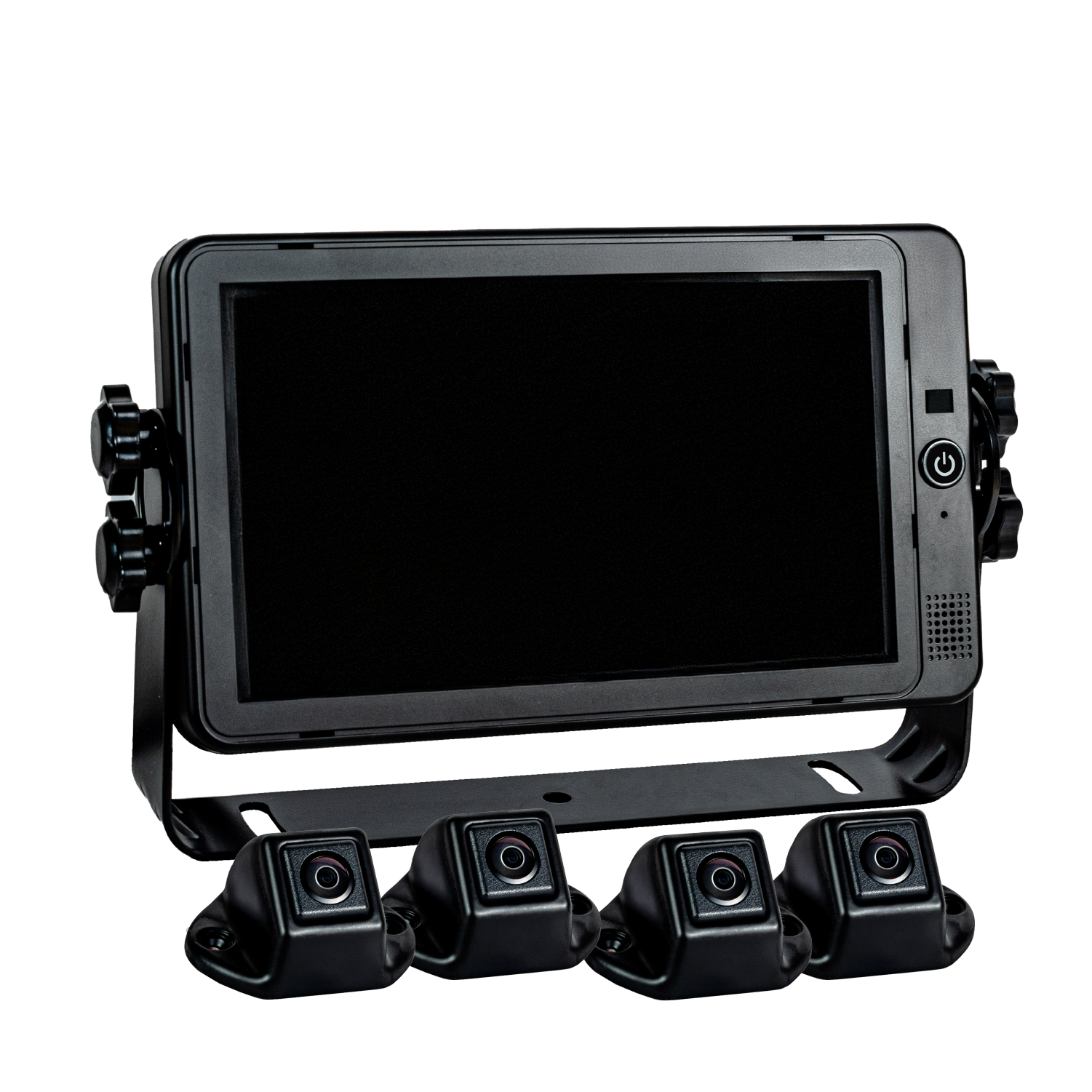
Where is surround view useful?
Typical applications include excavators, loaders, municipal vehicles and agricultural machines. The useful view depends on the task: the rear while reversing, the side beside a work area, or the space around a machine when turning. These are application examples, not claims about a particular customer installation.
360° view versus a split-screen monitor
A split screen shows separate camera images. A surround-view system processes images into an overview around the vehicle, often described as a top view or bird’s-eye view. Do not assume that every monitor with four camera inputs produces a stitched image. Check the actual display modes of the proposed configuration.
Does 360° viewing include AI detection?
The wide view and an automatic warning are separate functions. The view helps the operator see; AI assistance analyses the picture and may trigger an alert when a supported object is detected. Recording is another separate requirement. Confirm all three functions rather than relying on a model name.
What matters when installing cameras?
Camera placement must suit the shape of the vehicle and the parts that move. Assess the body, attachments, load and places where mounting is possible. Discuss calibration requirements, camera overlap and visibility close to the machine. The view should be checked with the actual vehicle in its working environment.
Which CAMEKO models should you compare?
The CAMEKO DVR 360 and DVR 360 PRO ranges are the starting point for a surround-view requirement with recording. If AI warnings are also required, specify that separately and confirm a compatible configuration. A live-view system or a DVR recorder alone should not be assumed to provide every function.
What information should you send for a proposal?
Send the machine type, photographs of suitable mounting positions, the areas that are hard to see and whether you need video storage. State whether the priority is reversing, turning, work around the machine or reviewing recorded events. This makes the comparison between configurations more useful.
Frequently asked questions
Will a 360° system remove every blind spot?
Do not assume complete coverage. Obstructions, mounting positions and the vehicle shape must be assessed and tested.
Is surround view the same as a reversing camera?
No. A reversing camera shows one direction; surround view provides a combined overview from multiple camera positions.
Can I add it to an existing machine?
The individual vehicle must be checked for installation space, supply voltage and a compatible camera configuration.
Machine visibility and loading control